
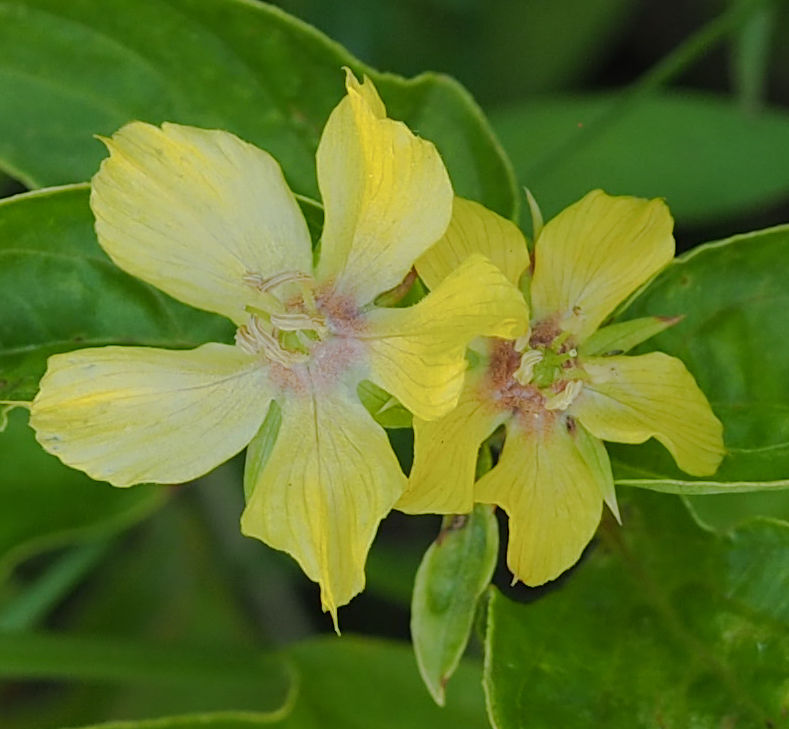

Bring a sunny splash of yellow to moist areas of your landscape with fringed loosestrife, an upright native perennial of the Primrose family that often goes unnoticed until it blooms in mid-summer with nodding, yellow flowers. The star-shaped flowers, which often display a burnt-orange smudge at the base of each petal, produce a floral oil from specialized glands known as elaiophores. The oil attracts a specialist oil bee known as dark-footed yellow loosestrife bee (Macropis nuda). After collecting the oil and pollinating the flowers, the bee transports the oil to its nest cell. It coats the nest with the oil to create a waterproof, homeostatic environment. Before sealing the cell, the bee leaves behind a nutritious mixture of oil and pollen for its young.
Fringed loosestrife is native to southern Canada and the US, including Alaska and most of the lower 48 states. A denizen of wetlands and moist woods, it thrives in full sun or part shade and rich soils with consistent moisture. It adapts to clay or sandy soils and tolerates seasonal flooding. For more abundant flowering, choose a sunnier spot. While it isn't as aggressive as the non-native gooseneck loosestrife (Lysimachia clethroides), this species does form a dense ground cover through rhizomes and self-seeding. The HOA may not want to see fringed loosestrife making its way through a formal border in your front yard, but this spreader is ideal for naturalizing boggy areas, rain gardens, woodlands, and ponds.
Ohio is home to eight native species of Lysimachia. Fringed loosestrife’s wider leaves and rhizomatous nature help to differentiate it from similar Lysimachia species. Lysimachia ciliata translates as "loosestrife with eyelashes," referring to the petioles (leaf stalks) that are covered in small hairs, giving the plant a fringed appearance.
Native habitats include wetlands, swamps, wet prairies and floodplains, thickets, bottomland forests, and stream banks. Plant in cottage or rain gardens, in boggy areas, along ponds or streams, or as a ground cover. Use in cut-flower arrangements.
Plant Characteristics:
Grows 1-4' tall and 1-2' wide.
Prefers full sun or part shade.
Prefers moist to wet, rich soils and adapts to clay and sandy. Tolerates seasonal flooding.
Five-lobed, 1" flower grows on slender stalk arising from leaf axil. Petals are broadly oval with a sharp, abrupt tip. Globoid, shiny green seed capsules dry and split to release several seeds.
Opposite leaves are up to 6" long and 2½" wide, rounded at the base and tapering to a sharp point at the tip. The petioles are narrowly winged and coated with long hairs. Smooth margins may have fine hairs.
Stems are smooth and unbranched.
Reproductive System: flower has both male and female parts (perfect/bisexual). Also produces vegetatively through rhizomes.
Wildlife Value:
Host plant for 4 species of Lepidoptera larvae: the consort, hitched arches, and specialists blurry-patched nola and loosestrife borer. Bees and flies visit for oil and pollen.
Medicinal, Edible, and Other Uses:
The plant is astringent and has been used to promote sweating and vomiting.
The live plant reportedly repels gnats and flies, and some people use a smudge fire of the plant as a fly repellant during the summer.
The cooked leaves of this plant are said to be edible.
Resources:
Illinois Plants
https://wwv.inhs.illinois.edu/data/plantdb/detail/818
iNaturalist
https://www.inaturalist.org/taxa/199154-Macropis-nuda
Lady Bird Johnson Wildflower Center
https://www.wildflower.org/plants/result.php?id_plant=LYCI
Minnesota Wildflowers
https://www.minnesotawildflowers.info/flower/fringed-loosestrife
National Wildlife Federation
https://nativeplantfinder.nwf.org/Plants/2033
North Carolina Extension
https://plants.ces.ncsu.edu/plants/lysimachia-ciliata/
Ohio Division of Wildlife
Ohio's Wildflower and Flora
https://www.facebook.com/groups/524478670918857/posts/27946765598263461/
Pollinator Patch Garden
https://www.thepollinatorpatchgarden.com/plants/fringed-loosestrife
Prairie Moon Nursery
https://www.prairiemoon.com/lysimachia-ciliata-fringed-loosestrife
