
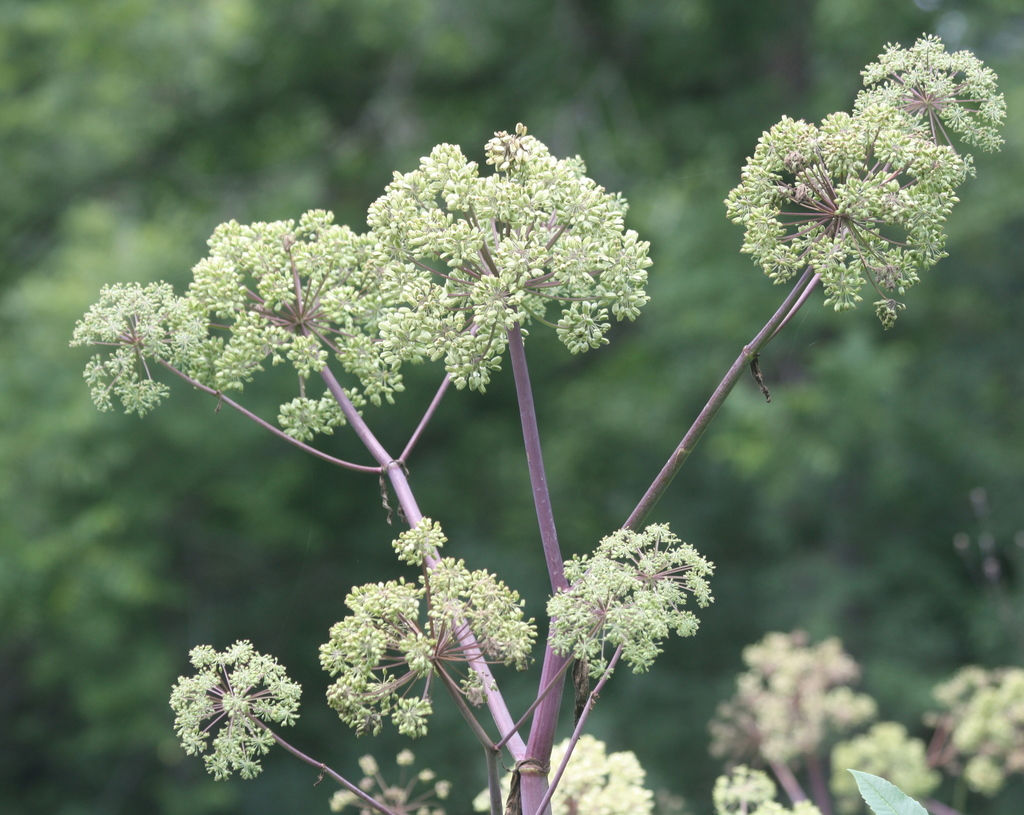

Explore a wetland in early summer and you may encounter a seven-foot plant straight out of a Dr. Seuss book. Great angelica has huge leaves, thick purple stems, and exploding fireworks of flowers swarming with insects. Often growing 6 to 8 feet tall, great angelica adds height and structure to the garden and serves as a decorative backdrop to perennials. This impressive biennial belongs to the Apiaceae family, whose other members include celery, carrot, and parsley. Defining features of plants in this family are uniquely scented flowers, hollow stems, and deeply divided leaves. As the common name implies, great angelica has especially large leaves composed of many leaflets. The plant starts out slowly the first year, focusing its energy on producing a deep taproot, stems, and leaves. Given consistently moist to wet soils and 4 to 6 hours of sun, great angelica reaches its full height and produces fruits and seeds during the second year. It self-seeds readily to ensure there will be blooms every year after the initial planting. Though great angelica prefers moist habitats, it may develop crown rot. The plant is challenging to transplant due to its deep taproot.
Also known as purple-stemmed angelica, alexander, American angelica, and masterwort, great angelica may be mistaken for cow parsnip (Heracleum lanatum), which is differentiated by its greenish stem, white flower petals, and palmately compound leaves with broad leaflets. Two other plants of tall stature--poison hemlock and water hemlock--also resemble great angelica, but they are extremely toxic to humans and animals, whereas great angelica has a long history of culinary use.
Native habitats include openings in bottomland woodlands, swamps, soggy thickets, edges of woodlands adjoining wetlands, marshes, roadsides, and the lower slopes of hillside seeps. Use in beds and borders, rain gardens, on the banks of water features, and in moist prairies or meadows.
Plant Characteristics:
Grows 4-8' tall and 2-6' wide.
Prefers dappled shade in warmer regions but grows in full or part sun in northern climes.
Prefers moist to wet, loamy or sandy soils and tolerates occasional flooding and wet sites.
Blooms May-June with convex to round clusters (umbels) 4-9" wide and composed of 20-45 smaller round clusters (umbellets) of 20-45 flowers each. The 1/4", star-shaped flowers are green to whitish with 5 petals, 5 spidery stamens, a divided style in the center, and 5 pointed oval sepals around the base. Oblong- or elliptic-shaped fruits are about 1/4" long with thin, winged edges.
Alternate, bi-pinnate compound leaves grow primarily along lower half of plant. Lower leaves, which are up to 2' long and wide, have 3-5 leaflets on a branch. Lance-shaped leaflets are up to 4" long and 2" wide, sometimes with one or two deep lobes, especially on the end leaflet. Margins are sharply toothed and leaf surfaces are mostly smooth.
Large hollow stems are pale purple to dark purple, cylindrical, smooth, and often endowed with a waxy bloom.
Reproductive System: flower contains both male and female parts (perfect/bisexual) and is pollinated by insects. It's self-compatible (produces viable seeds through self-pollination) but benefits from cross-pollination, which promotes genetic diversity.
Wildlife Value:
Host plant for larvae of black swallowtail butterfly and umbellifer and cow parsnip borer moths. The nectar attracts syrphid flies, bee flies, and adrenids and other small bees.
Medicinal, Edible, and Other Uses:
Native Americans used a tonic made from the roots for colds, fever, headaches, sore throats, stomach disorders, rheumatism, and pneumonia. The leaves, seeds, and roots have been used as a general tonic for women. A poultice was used to treat broken bones and swellings.
The tender stem is the strongest tasting, most versatile part of the plant. Boiled and peeled stems serve as an aromatic side for savory meats. They are also candied for use in baking and decorating. The blossoms are eaten as a vegetable or dessert, and the dried seeds are used similar to fennel seeds. The slightly bitter leaves add carrot-like flavor to salads. The extremely hard root is used to infuse liquors or make syrup.
Resources:
Forager Chef
https://foragerchef.com/angelica/
Gardenia.net
https://www.gardenia.net/plant/angelica-atropurpurea
Go Botany
https://gobotany.nativeplanttrust.org/species/angelica/atropurpurea/
Illinois Wildflowers
https://www.illinoiswildflowers.info/wetland/plants/grt_angelica.html
Minnesota Wildflowers
https://www.minnesotawildflowers.info/flower/angelica
Morton Arboretum
https://mortonarb.org/plant-and-protect/trees-and-plants/great-angelica/#!
PubMed Central
